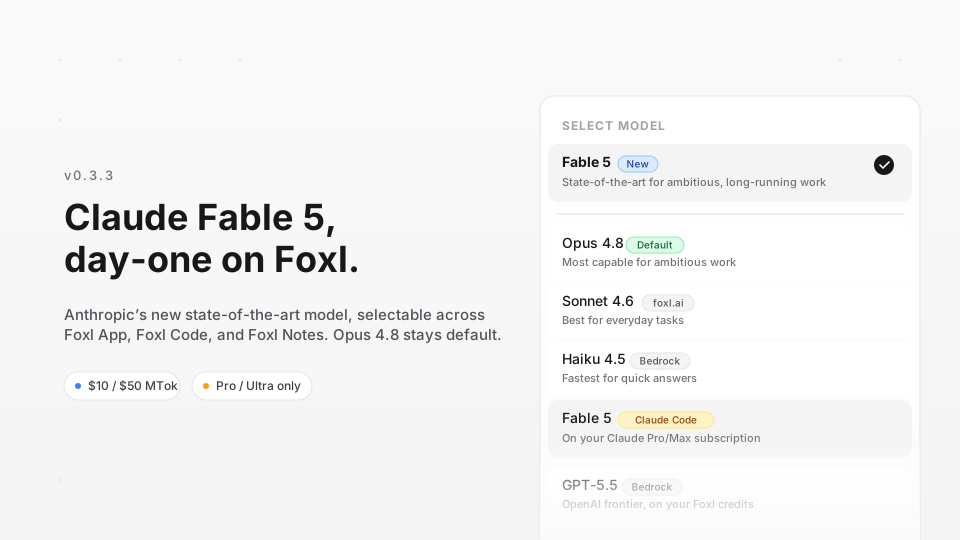
Foxl v0.2.5 adds day-one support for Claude Opus 4.7. It is now the default model in Foxl.
What is better in Opus 4.7
Opus 4.7 is a direct upgrade from 4.6. The biggest gains are in agentic coding: it handles long-horizon autonomy, systems engineering, and complex code reasoning better than any previous Claude model (87.6% on SWE-bench Verified, 69.4% on Terminal-Bench 2.0). It can be handed hard coding tasks that previously needed close supervision and run them to completion with confidence.
For knowledge work, the model produces more polished documents, slides, and financial analyses. It reasons through underspecified requests by making sensible assumptions and stating them clearly, then self-verifies its output before reporting back.
Instruction following is substantially improved. Prompts written for older models may need re-tuning - where previous models interpreted instructions loosely, Opus 4.7 takes them literally.
Vision gets a resolution upgrade: images up to 2,576px on the long edge (3x previous models), improving accuracy on charts, dense documents, and screen UIs. Memory is also better - the model remembers important notes across long multi-session work and carries context forward with less repetition.
Opus 4.7 also introduces a new xhigh effort level between high and max, giving finer control over the reasoning-vs-latency tradeoff on hard problems.
What changed in Foxl
Opus 4.7 is now the default model. The auto-routing system sends expert-level tasks to it, while simpler work still goes to Sonnet or Haiku. If you prefer 4.6, it is still available in the model selector.
We also fixed adaptive thinking compatibility. Opus 4.7 only accepts thinking.type: "adaptive" (the older "enabled" format is rejected). All Opus and Sonnet 4.6+ models now use the adaptive format automatically. Haiku 4.5 continues to use budget-based thinking.
Stability
Fixed an Electron crash caused by the tunnel client writing to a closed server pipe during shutdown (EPIPE). The main process now catches these silently.
Migration note
Opus 4.7 uses an updated tokenizer. The same input can map to roughly 1.0-1.35x more tokens depending on content type. The model also thinks more at higher effort levels, especially on later turns in agentic work. You can control this with the effort parameter or by prompting the model to be more concise.